Thursday, August 15, 2013

5 Tips for Safe Handling and Use of Pesticides


What are pesticides?

According to the Department of Agriculture, “Pesticides are natural or synthetic chemicals that kill, attract, repel, or otherwise control the growth of pest plants, animals, and microorganisms.” Basically, pesticides are bug and weed killers.  They are all toxic, but the amount that is needed to cause an effect varies greatly. Some are toxic to people, pets or wildlife in amounts as small as a tablespoon where others may take gallons. Concentrated products that are designed to be mixed with water before application are usually more toxic than ready-to-use products that are applied without any mixing.

How do you use these products safely?

1) The best way to avoid the hazards of pesticides is to not use them. Visit our Common Sense Gardening web page for gardening and lawn care guides or (360) 867-2674.

2) Research what will most effectively solve your pest problem. A helpful guide to aid in the selection of pesticide products that are rated low hazards can be found in the Grow Smart Grow Safe guide. 

3) Read the directions before you buy it.
Before you purchase a pesticide, read the directions and precautionary statement. Be certain that you are willing, able, and comfortable handling and using the product. And purchase only the amount you need. The less hazardous products you have stored around your home, the less likely your family and pets are exposed to them.

4) Re-read the directions each time you use it and follow them.
All pesticide products contain directions that describe how they should be applied and precautions about potentially hazardous situations. If there is a known hazard, there will be a direction to avoid the hazard. For example, corrosive liquids may require the applicator (that’s YOU) to avoid skin contact by wearing gloves, clothing to cover skin, glasses and/or goggles.

Here is an example of a precautionary statement from a potentially corrosive moss control product:

WARNING: Causes substantial but temporary eye injury. Causes skin irritation. Do not get in eyes, on skin or on clothing. Wear protective eyewear (goggles, face shield or safety glasses). Wash thoroughly with soap and water after handling. Remove contaminated clothing and wash before reuse. 

Here is an example of a precautionary statement from a potentially toxic fungus control product:

CAUTION: Harmful if swallowed or absorbed through skin or inhaled. Causes moderate eye irritation. Avoid contact with eyes, skin or clothing. Avoid breathing spray mist. Prolonged or frequently repeated skin contact may cause allergic reaction in some individuals.

General Precautions and Restrictions: Do not allow people or pets to enter treated areas until sprays have dried. Do not apply this product in a way that will contact other persons or pets, either directly or through drift.

The second label warns the applicator to avoid contact with eyes, skin or clothing – it does not specifically tell the user how to avoid contact (use of gloves, goggles, waterproof clothing).

5) Dispose of unused, unwanted pesticides properly – take them to HazoHouse to be disposed of properly for free. HazoHouse is a household hazardous waste disposal location at the Thurston County Waste and Recovery Center (formerly the landfill). Disposing of hazardous products safely keeps them from polluting our water ways, makes sure that kids or pets don’t accidentally get into them and is free and easy!

Thursday, August 8, 2013

Keep your Well, Well!


It’s easy to go about our day and not think about where the water we use comes from. In Thurston County, we drink groundwater and that water comes from either a household, neighborhood or city-owned well.

Well water comes from, groundwater, fed by underground aquifers. When the rain falls, about half of it soaks into the ground and becomes groundwater. The soil does a pretty good job filtering it as it makes its way underground but pollution on the ground can end up in the well.

Steps you can take to protect your well water:
  • Inspect your well casing. Cracks can lead to contaminants making their way into well water.
  • Inspect the cap or cover on top of the well casing.  There should be no openings, including around electric wires. The cap should have a gasket, making a watertight seal.  If you try to wiggle the cap, it should not move.  There should be a goose neck vent, screened with a fine mesh.  
  • Keep the top of your well at least one foot above the ground.
  • Keep animals and their manure 100 feet away from your well. 
  • Keep household and yard chemicals, such as pesticides, auto products, and any other products with words such as caution, warning, danger, or poison away from your wellhead. Do not store them in your pump house or within 100 feet of your well. 
  • Avoid using or mixing fertilizers and pesticides within 100 feet of a well. 
  • Don’t pile leaves, snow, or other materials around your well. 
  • Slope the ground away from your well.  This will help rainwater that may contain surface contaminants (such as pesticides and oil) drain away and not pool around the well. 
  • Have your well water tested for bacteria once a year. Test for nitrate at least every three years, before bringing home an infant, and when a woman living in the home is pregnant, nursing, or trying to become pregnant.

These precautions help keep your drinking water safe and healthy.  These tips can also save money and time by preventing problems that can be costly to clean or repair. We know we need to drink several glasses of water each day, make sure that it is the best water that it can be! 

For more information, visit Thurston County Environmental Health's website.

Thursday, August 1, 2013

Common Sense Gardening: Spotlight on Summer Watering


It can be hard to believe that in the famously rainy Pacific Northwest water conservation is important, especially in the summer.  It is true that rain falls for many months of the year BUT during the summer months when we use thousands of gallons of water each day to cultivate lush yards, we get less rain than Tucson, Arizona! 

To conserve water in the yard and garden, water as needed in the morning before the sun has a chance to send it all back up as evaporation. Evening is the second best time to water, but wet leaves overnight can encourage fungus and disease. Water saving tools such as soaker hoses and drip lines work well and give water directly to your plants’ roots.  They can also prevent weeds by watering only the plants that need it most. 


Keep water off of the areas that can’t grow such as driveways, sidewalks, and other non-planted areas.  It sounds so simple and yet we often see sprinklers giving precious water to parking lots and other areas from which water simply runs off.

Lawns are less thirsty if we let them go to sleep (dormant) for the summer.  Yes! The lawn may turn brown. No! It will not die. Water deeply but slowly (so that the water doesn’t pool or run off) once each rainless month to support a dormant lawn and try to avoid heavy use.  If you have high-traffic areas, such as grassy walkways or play areas, water those areas only (one inch per week) to prevent damage.  A drier lawn is less likely to encourage crane flies and disease. When the rains return in the fall, over seed any thin areas to thicken the lawn and help crowd out weeds.

Some other water-saving tips:
- Choose native or drought-resistant plants.  They don’t need additional watering after they are established, usually within two years.
- Install rain barrels to save up those winter rains for summer use.
-  Check outdoor faucets for leaks (and fix them!)
- Adjust automatic irrigation systems.  Many are set up for landscapes that are just getting established. So make sure yours is adjusted to the landscape you have now.
- Add compost to the soil and mulch around plants to prevent weeds and conserve water.
- Use a broom rather than a hose to clean sidewalks and driveways.

Help save water for where we need it most – Drinking!

For more information visit our Common Sense Gardening website or call (360) 867-2674.

Friday, July 26, 2013

Shellfish Harvesting Closed in Olympia's Budd Inlet


This advisory is no long in place.
A marine biotoxin that causes diarrhetic shellfish poison (DSP) has been found at unsafe levels in shellfish at Budd Inlet in Thurston County. 
Washington State Department of Health and Thurston County Public Health have closed all of Budd Inlet to recreational shellfish harvesting.  The closure includes lower Budd Inlet (where shellfish harvesting is never advised) and extends all the way out to Boston Harbor and the tip of Cooper Point.  
Warning signs have been posted at public beaches alerting people not to collect shellfish.
What you should know about DSP:
  • DSP biotoxins are produced by naturally occurring algae. They can build up in the flesh of molluscan shellfish, such as clams, mussels, oysters and geoducks and make shellfish unsafe to eat.
  • DSP biotoxins are not destroyed by cooking or freezing.   
  • Symptoms can begin 30 minutes to 12 hours after eating contaminated shellfish. Diarrhea is the most commonly reported symptom but the toxin can also cause nausea, vomiting, and abdominal pain.  Most symptoms subside within 72 hours.
  • Shellfish harvested commercially (available in stores and restaurants) are tested for toxins prior to distribution, and are safe to eat.
DSP biotoxin is a new health concern for waters in Washington State. The first confirmed cases of illness caused by DSP in Washington State were in July 2011, when three people got sick after eating shellfish harvested in Sequim Bay in Clallam County. 
This Budd Inlet closure is the first DSP closure to occur in South Puget Sound waters.
Recreational shellfish harvesters should always call the Washington State Department of Health Biotoxin Hotline at 1-800-562-5632 or check the DOH website at www.doh.wa.gov/shellfishsafety.htm before harvesting shellfish anywhere in Washington.  

Thursday, July 18, 2013

Scatter Creek Community Open House & Workshop on July 30

You are invited to an open house and community workshop about the Scatter Creek Aquifer project, hosted by the Scatter Creek Aquifer Project Citizens Advisory Committee and Thurston County Environmental Health.

When:             Tuesday July 30, 2013
                        6:30 – 8:30 p.m.

Where:            Rochester Middle School Commons
                        9937 Highway 12 SW
                        Rochester, WA 98579

Schedule:        Open House: 6:30-7:30 p.m. (includes children’s area)
                        Presentations: 7:30-8:00 p.m.
                        Questions: 8:00- 8:30 p.m.


The Scatter Creek Aquifer is susceptible to groundwater contamination because the area’s sandy, gravelly soils do not filter out contaminants well. Unlike many other areas, there is not a deeper aquifer below, which makes it the only source of drinking water for more than 18,000 residents.

Project activities include groundwater monitoring, groundwater modeling, and meeting regularly with a Citizen Advisory Committee to determine the best course of action to protect drinking water now and in the future. For more information visit the project website. 

This event is an opportunity for the community to learn more about the project and provide input.  For more information, or to sign up for email updates contact ScatterCreek@co.thurston.wa.us or (360) 867-2582.

Friday, July 12, 2013

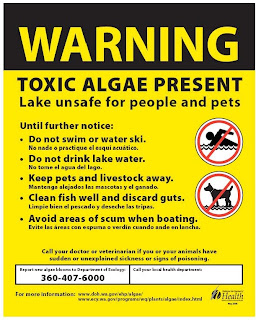
Blue-green Algae Blooms

What is a blue-green algae bloom?
Blue-green algae, or cyanobacteria, reproduce quickly in fresh water when the conditions are right with sunlight, warm temperatures, and nutrients. In a few days, a clear pond or lake can become cloudy with algae growth. This is called a bloom.
A blue-green algae bloom can look like paint floating on the water and it can vary in color from bright green, or a bluish, brownish, or reddish green. These blooms can occur any time of year, but are most common in the summer and fall.

What is a toxic bloom?
Not all blooms are toxic. Some blue-green algae produce toxins or poisons that eventually break down and are destroyed naturally. Ingesting the algae while they are poisonous can cause serious illness.
What if I see a bloom?
If you notice a bloom or signs of poisoning, avoid all contact with water containing algae. Keep children, pets and livestock away from the water. Call Thurston County Environmental Health Division at (360) 867-2626 to report the bloom. If the bloom is outside of Thurston County, call the local health department or Washington State Department of Ecology at (360) 407-6000 to report it.
Contact with Blue-green Algae can be Poisonous!
Blue-green algae can produce nerve toxins and liver toxins. Call your doctor or veterinarian right away if you or your pets have signs of poisoning.

Signs of neurotoxin poisoning appear within 15-20 minutes after ingestion.
- In people, signs may include numbness of the lips, tingling in fingers and toes, and dizziness.
- In animals, signs include weakness, staggering, difficulty breathing, convulsions, and death.

It may be hours or days before signs of liver poisoning appear.
-  Liver toxins can cause abdominal pain, diarrhea and vomiting in humans and death in animals.

If a test shows that a bloom is toxic, county health officials will decide whether to issue a health advisory for the lake. Notifications are posted at the lakes. Health officials will continue to test the lake until it is safe to lift the health advisory.
Visit Thurston County Environmental Health Division’s website to check for lake advisories.  

Tuesday, July 2, 2013

Tips for Safe Grilling

The sun is out just in time for the holiday! So let’s get out there and enjoy it while it lasts. A traditional sunny day activity is outdoor grilling. There can be a lot of distractions at a BBQ - friends and family to talk to, kids and pets running around, food dishes being passed back and forth… with so much going on, one thing should remain at the top of your list: food safety.
Here are some tips for safe grilling:
  • Marinate foods in the refrigerator - never on the kitchen counter or outdoors. If you plan to use some of the marinade as a sauce on the cooked food, save a portion separately before adding the raw meat, poultry, or seafood. Don’t reuse marinade.
  • Cook immediately after "partial cooking." If you partially cook food to reduce grilling time, do so immediately before the food goes on the hot grill. Cook food thoroughly. When it’s time to cook the food, have your food thermometer ready. Always use it to be sure your food is cooked to a safe internal temperature.
  • Keep cooked food hot. Move cooked grilled food to the side of the grill rack, just away from the coals to keep it hot until served.
  • Don't reuse platters or utensils that previously held raw meat, poultry, or seafood because bacteria from raw food juices can spread to the cooked food. Have a clean platter and utensils ready at grill-side to serve your food.
  • Once served, cold food or hot food should not sit out for longer than two hours, or one hour if the temperature is above 90° F. If it does - throw it away. Otherwise, keep cold food at 40°F or lower and hot food at 140°F or higher.
  • Pay special attention to children and pets around the grill to prevent burns or other injuries. If you used any lighter fluid to start your grill, make sure you placed it in a secure location – away from heat, out of reach of children, where it cannot spill.
For more food safety information visit www.foodsafety.gov.
Thurston County Environmental Health staff wishes everyone a fun, safe, and tasty summer!